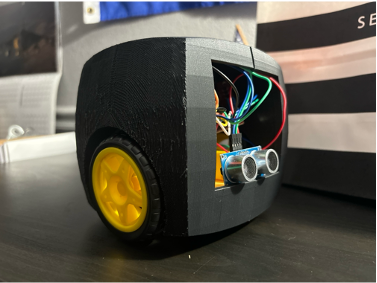
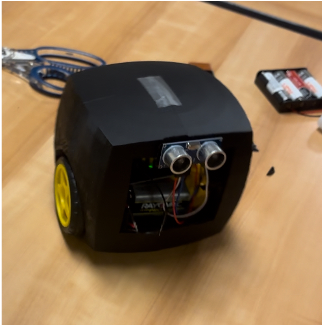
Education Robot
EGN 3000L
Manufacturing Education Robots
🔬 [Project Lead] Fabian Martin, [Hardware Lead] Robert Tortolo, [Software Lead] RC Wyatte, [Test Lead] Erik Langschwager, [Design Lead] Lauren Song
Timeline: : Jan 2024 - April 2024
Key Tools: : Arduino, ThinkerCAD, Flashprint
Note: Use a desktop browser to view the interactive table of contents.
- Introduction
- Project Plan
- Prototype Design
- Product development
- Software development
- Prototype testing
- Recommendations
- Conclusions
- References
Introduction
Our Project’s main goal is optimize the final design candidate, Wheelie, for K-12 STEM education and reduce the barriers to entry into engineering education. The purpose of this project is to broaden the diversity of learning activities for future potential enginners through the robot, Wheelie, which will be used as an educational tool.
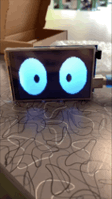
By integrating various features such as sensors, motors, and interactive LCD screens that display emoji expressions, Wheelie provides hands-on learning experiences that encourage curiosity and exporation. Through the assembly process, we aim to make engineering learning enjoyable and easily accessible, while encouraging students to interactively explore concepts in robotics engineering.
Overall, our project, Wheelie, not only provides hands-on experience by assembling electronic components and understanding engineering theoretical concepts but also contributes to lowering the participation and entry barriers in the field of engineering, thus relating to K-12 STEM education.
Project Plan
Bills of Materials:
| Materials | Amount |
|---|---|
| Arduino | $4.27 |
| Ultrasonic Sensor | $3.40 |
| Battery | $2.00 |
| 2/Pack DC Motors | $1.80 |
| 2/Pack of Wheels | $3.32 |
| 8GB Micro SD Card | $8.29 |
| 3.5” TFT LCD Display | $17.83 |
| Total | $39.11 |
Prototype Design
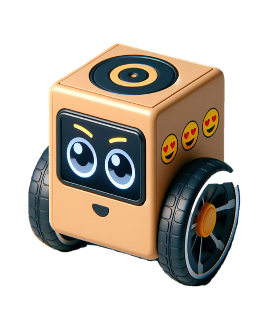
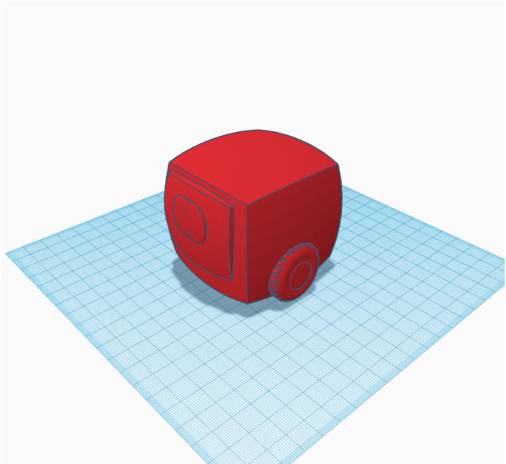
The chosen design, called Wheelie, was selected over other ideas for several reasons. Its box-shaped body with a minimalist approach and an LCD screen face allow for easy assembly within a few minutes by any user, unlike other candidates that are harder to assemble. Additionally, Wheelie incorporates three wheels for stability, making it suitable for navigating indoor environments typically found in schools. Lastly, considering the customer’s budgetary constraints, our candidate design ensures cost-effectiveness, with the cost expected to be under $40.
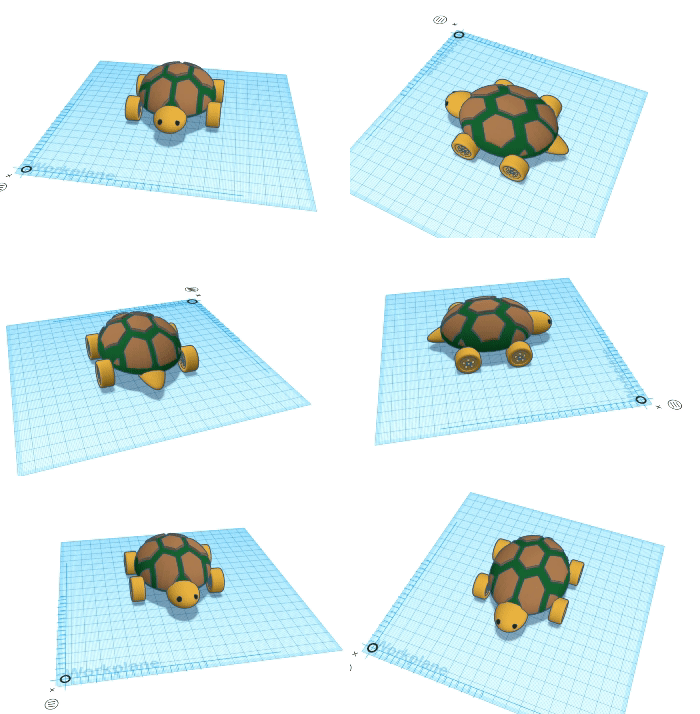
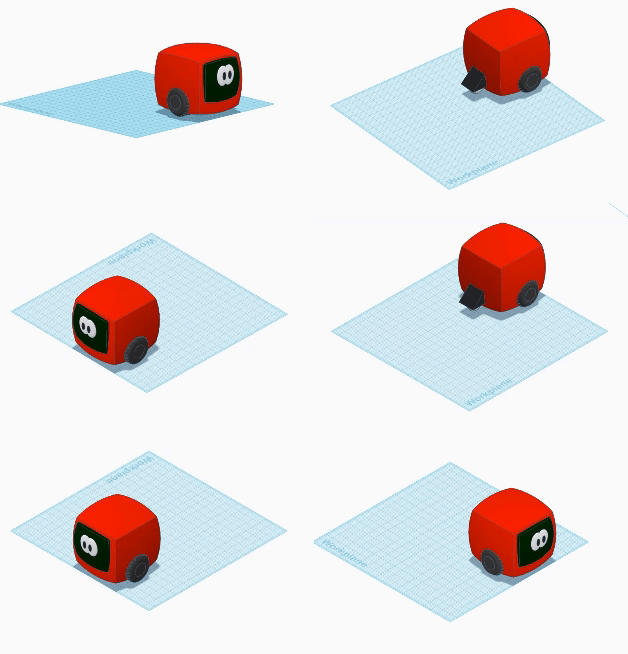
Based on the Figure 2, our final candidate design calculations and specific components are:
- Box-shaped body
- LCD Screen face
- Two Wheels
- Ultrasonic Sensor
- Two motors
- Power source such as 5V battery
- Arduino Uno
Product development
Software development
Prototype testing